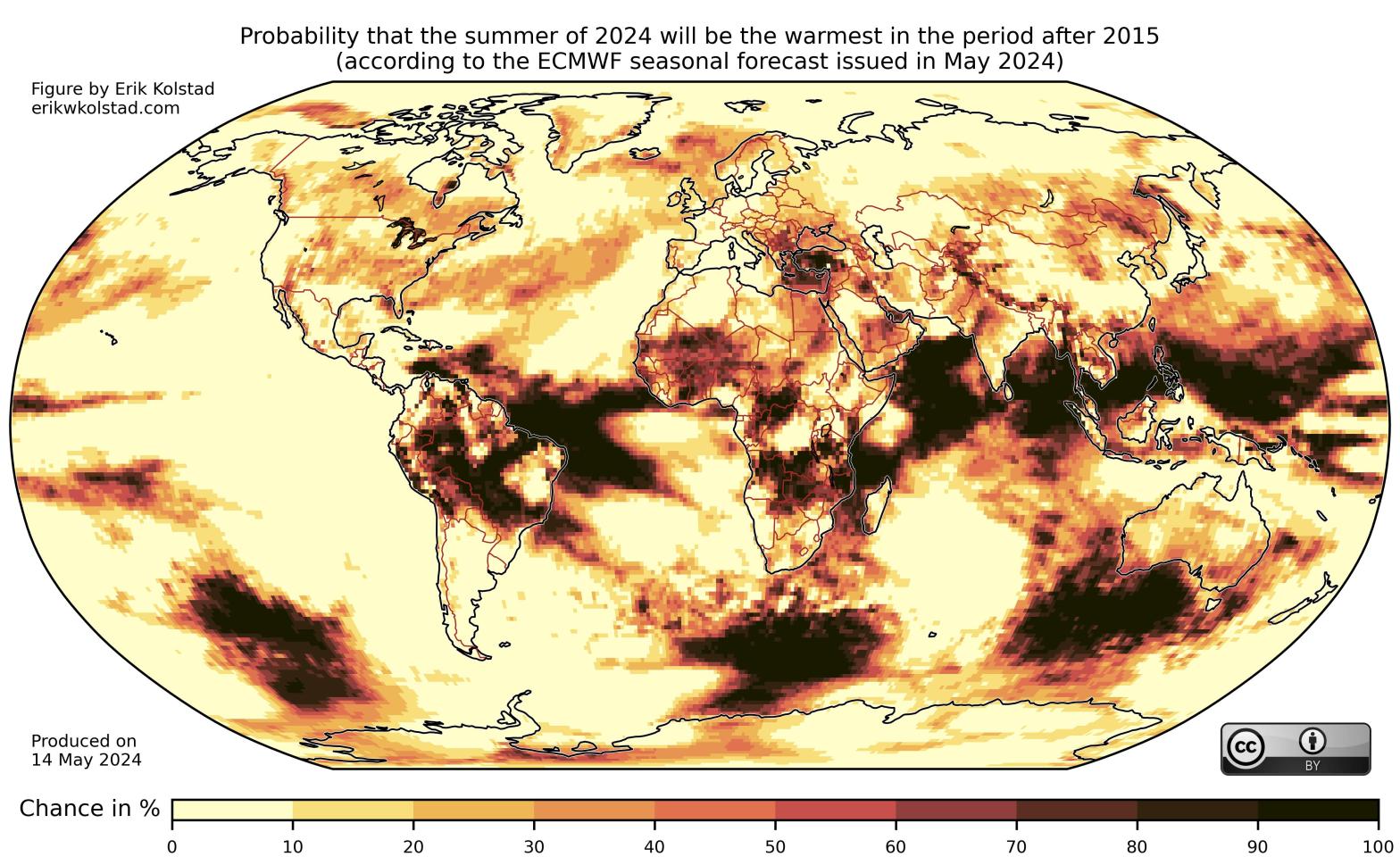
In Climate Futures, we’ve tried something new this year. Rather than comparing the seasonal predictions for the boreal summer to a normal period – which seems to be a very abstract concept to most people – we’ve compared it to the last nine years. When we include 2024, this gives us a nice 10-year period as a reference. The great thing about this period is that (most) people are able to remember some of the years in it; for instance, the hottest summer.
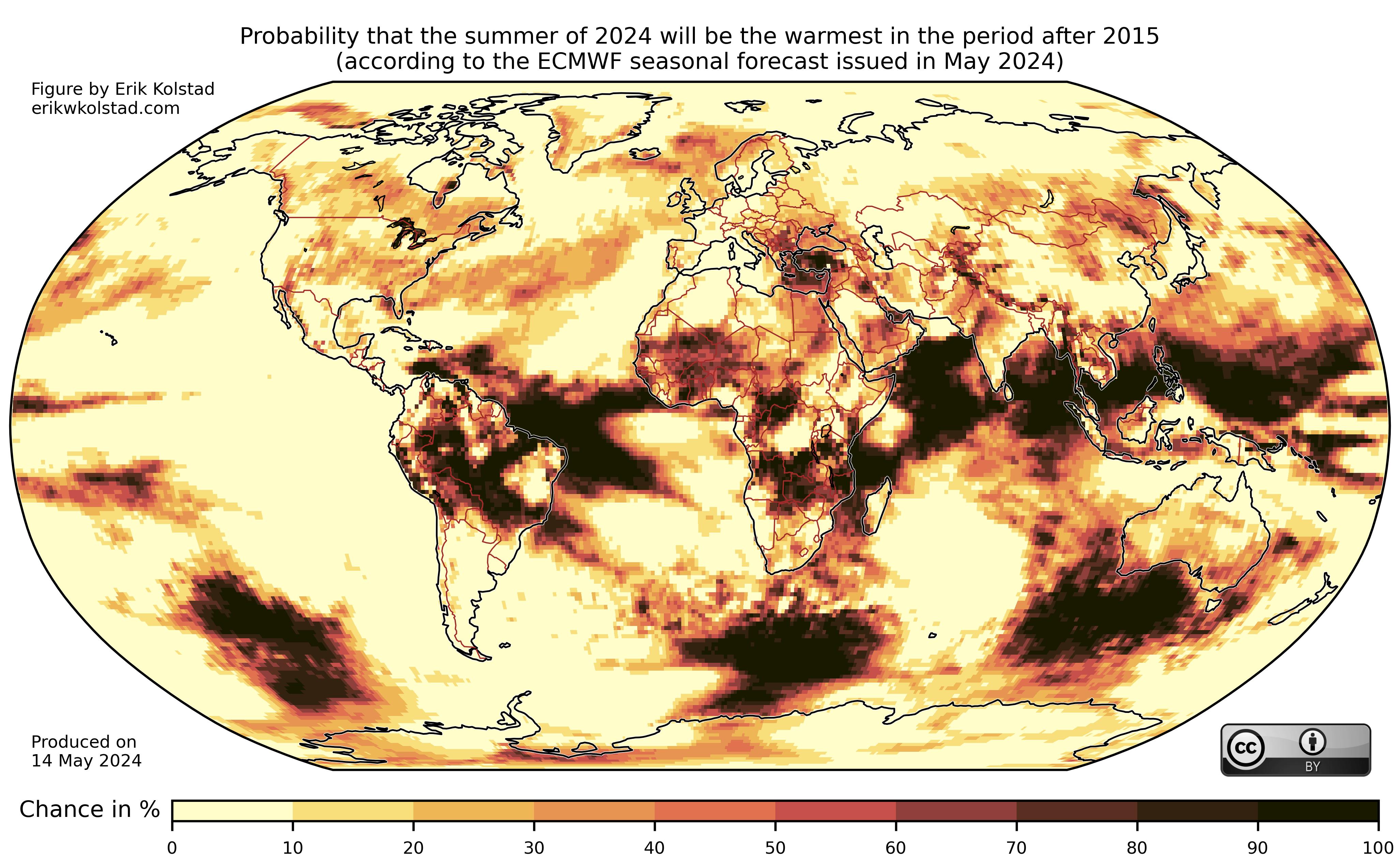
In the figure below, we’ve estimated the likelihood (according to one prediction model) that June–August 2024 will be the warmest such period over the last 10 years. In most locations worldwide, the chance is about 10%, which is the default statistical probability (one in 10 years = 10%). However, in other regions, like the eastern part of the Mediterranean, West Africa, and large parts of Brazil, the likelihood is substantially higher.
Comparing the likelihood of any event to just one previous observation is risky in the world of statistics. It is more robust to use a percentile as the reference. The figure below shows the estimated likelihood that June–August 2024 will be among the top three warmest boreal summers in the period starting with 2015.

The default probability is 30%, but according to the forecast model it is much more likely than that in many areas. The regions that were mentioned when discussing the previous figure are still in the high probability range, but other areas, like Mexico and Norway, are now deeply in red terrain.
I conclude by reminding everybody that the uncertainty associated with June–August forecasts produced as early as May is high. Here’s a validation figure for the ECMWF model:

Details can be found here, but the short story is that forecast skill is low in the stippled areas, which include most of Europe.
 Erik Kolstad