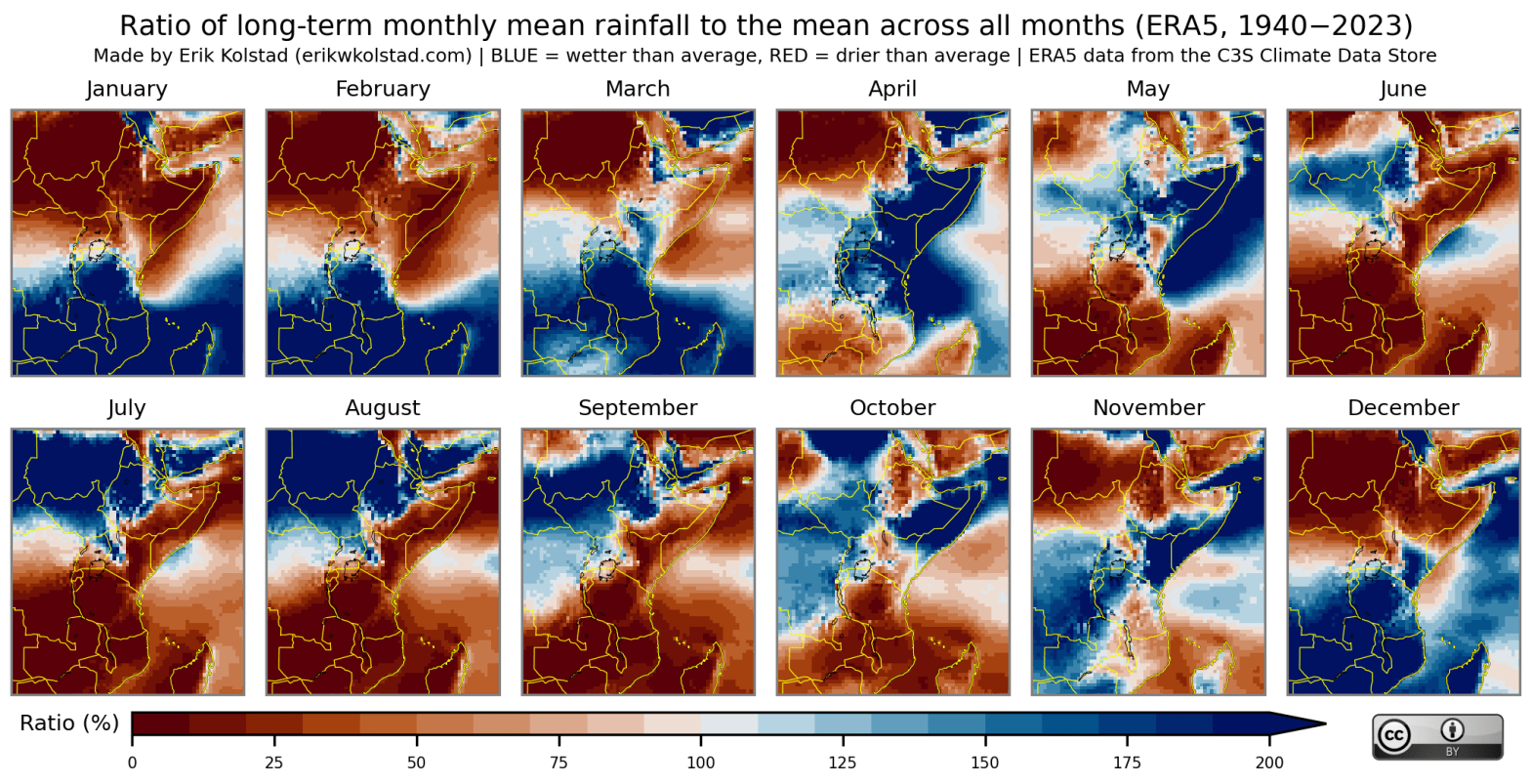
East Africa experiences several rainy seasons, depending on the geographical location. In the figure below, I have computed the long-term monthly mean rainfall for each month and divided this by the long-term monthly mean rainfall across all months. When the ratio is above 100% for a given month, it means that it rains more on average during that month than the average across all months of the year.

Taking Ethiopia as an example, we see that the entire country experiences dry conditions from December to February, also known as the Bega period. The Belg rainy season in the central and eastern parts of the country starts in February/March and lasts until May. In western and central Ethiopia, the Kiremt season starts in May/June and lasts until September. There is then an abrupt shift to dry conditions in the western areas in October. In the same month, wet conditions start in the central and eastern regions. This rainy season, which is known more broadly as the East African «short rains», persists until November in the southern part of the country.
Malawi is another interesting case. This country is mainly dry between April/May and November, and mainly wet from November/December to April/May. In other words, there is a long lean season and a long, single rainy season. From year to year there can be large variations from this average pattern, however.
 Erik Kolstad