In the scientific literature, the classic El Niño impact has been: cold winters in northern Europe. This is because it has traditionally been linked to the negative phase of the North Atlantic Oscillation (NAO). In such negative phases, northern Europe gets cold and dry weather, while mild and wet conditions are expected in southern Europe. The reason is that storms in the North Atlantic are shifted southwards and hit Continental Europe instead of Norway.
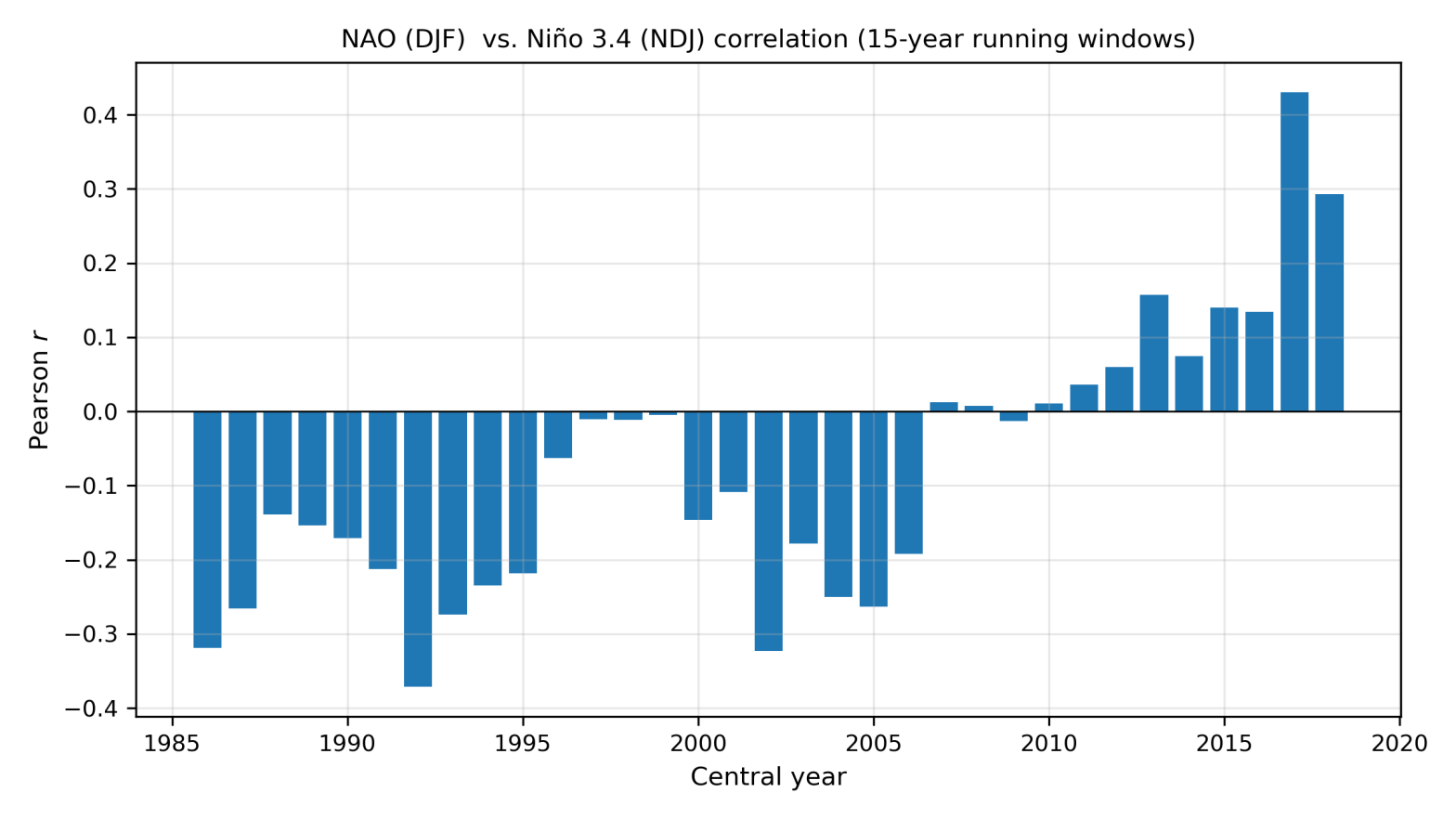
The graph below shows the correlation between an index representing the NAO in winter (December–February) and another index. This one, which is evaluated slightly before (November–January), to allow time for effects to propagate from the tropics to the mid-latitudes, is called Niño 3.4, and it is positive during El Niño and negative during La Niña. The correlations are shown for 15-year long, overlapping windows.
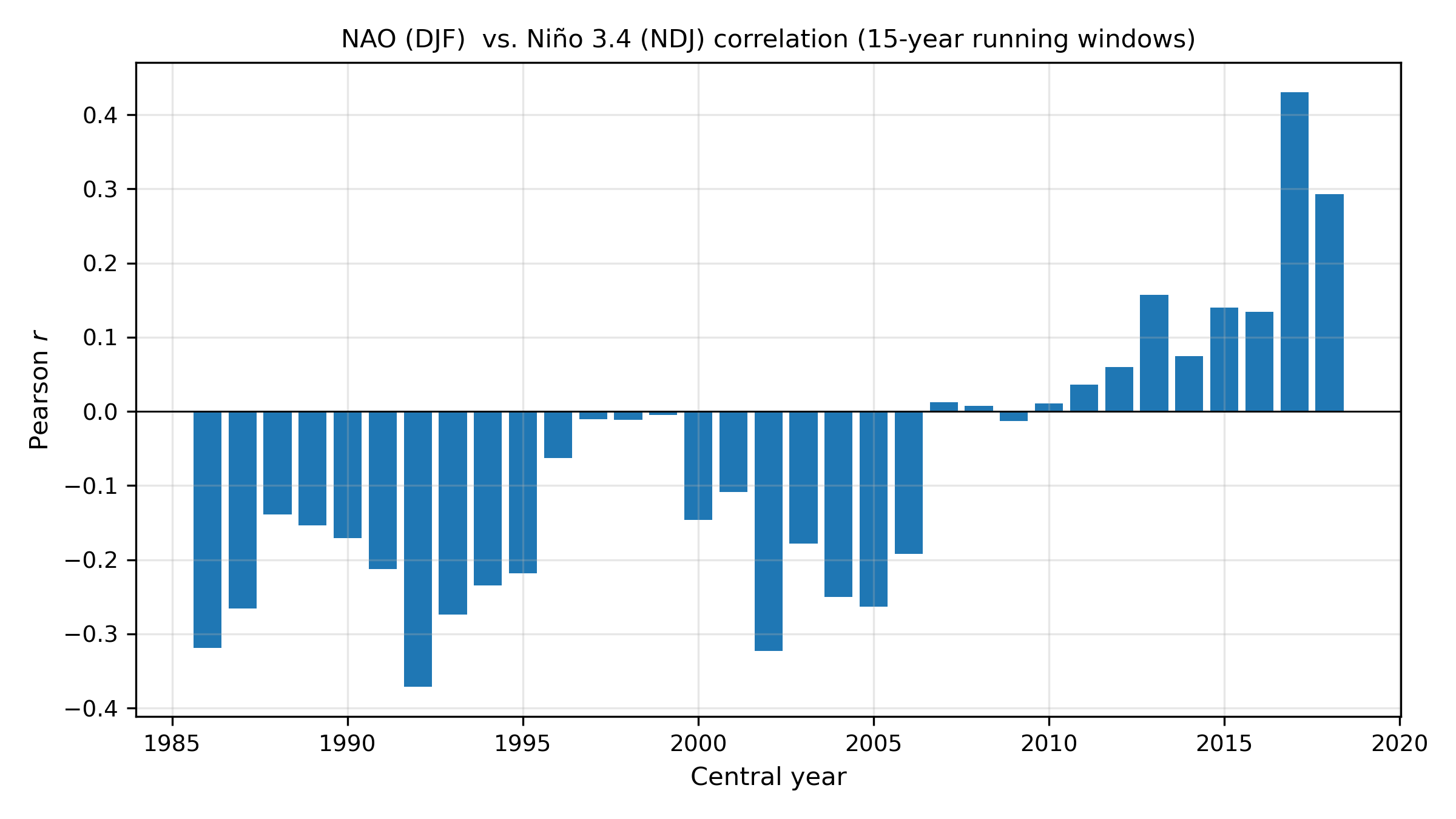
It is immediately clear that the correlation has changed over the years. Of most relevance to us now is that the correlation has been positive in recent years, whereas it was negative or neutral for a long time, up to the 15-year period centred on 2010. You may have seen lot of posts or articles warning us about a cold winter because of El Niño, but these forecasts may be based on a correlation that simply doesn’t exist anymore.
Last winter the NAO was distinctly negative, and this occurred during La Niña conditions. This fits with the “new” correlations, but not with the “old” ones.
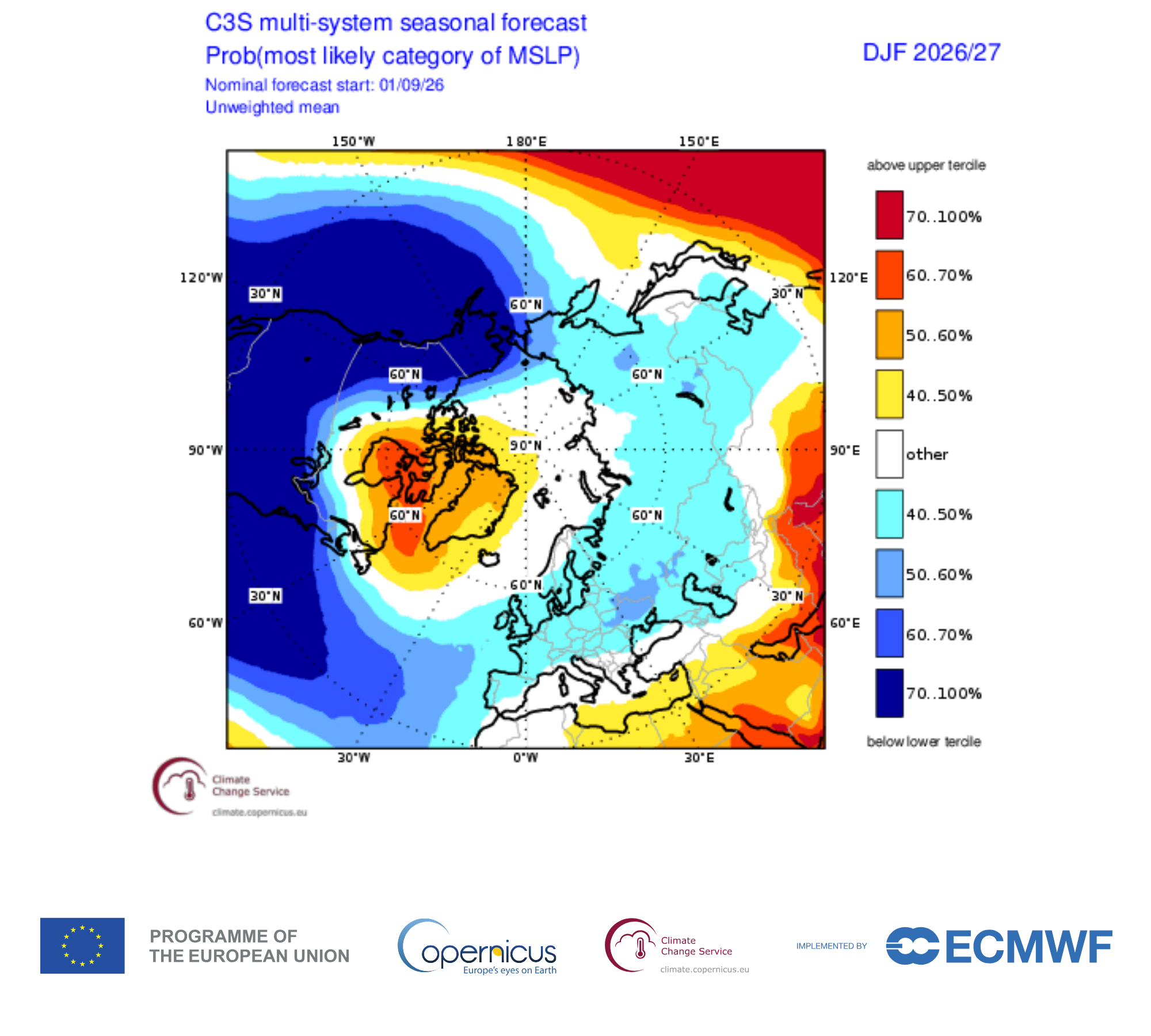
A caveat is that the correlation has been weak in all the periods; its maximum is slightly above 0.4, which is quite low. In other words, there could be something going on with the current El Niño that makes negative NAO conditions more likely, despite the positive correlation in recent decades. The latest seasonal forecasts do in fact indicate an increased likelihood of a negative NAO this winter, as shown in the picture below. The red colours around Greenland and the blue colours further south in the North Atlantic are typical of negative NAO conditions.
It will be interesting to take stock after the winter and see whether El Niño played a significant role.

